As you may have noticed, there's been a change in flavour around here.
This has never really been much of a Library blog: the social media rules of my workplace (and the lack of interesting blog posts to write about such things) keep me from really digging into that the way I might have liked. And I wanted to focus this blog a little more narrowly than the sort of scattergun approach it has had.
And so it is becoming a predominantly "history/ical" blog.
Yep - an entirely made up term. By which I mean that my focus is going to be on works of historical fiction and nonfiction history. I doubt that I'll ever be reading the very latest releases when they're released: I've got a lengthy backlog of both Chadwicks and Gregorys, not to mention my "Reading the Morlands" or the fact that I'm working my way through most of what Jean Plaidy ever wrote. I'm also hoping to start posting about historical TV adaptations like The Tudors or the bits of history in the Great British Sewing Bee (love those! Also hoping to blog the rest of the show on Chez Stutters at some point soon.)
With the introduction of the Sunday Reads posts I've established a place to discuss non history/ical current reads - at the moment that seems to be predominantly sci-fi.
I will still post other things here: other topics, reviews of other types of books. I'm not giving up on my obsession with dystopias any time soon!
But as it (now) says up the top - "Heidi Reads - mostly history/icals"
Wednesday, 1 October 2014

Tuesday, 30 September 2014
Reading the Morlands: "The Princeling", completed

On looking at the next book in the series (The Oak Apple), I found that it had skipped James I and VI entirely, and I found this to be quite a shock. But in thinking about it, there's a reasonable gap between The Dark Rose and The Princeling as well. Long enough, at least, for Nanette to spirit Mary Seymour away in really interesting use of the ambiguity of history.
The Princeling opens with Nanette and James Chapham at home with Jan, their own boy Alexander, and Mary Seymour. One probably has to be a devotee of Tudor history, and particularly of Henry VIII's final wife, Katherine Parr, to realise what a shock that was for me to read. 'But Mary Seymour died!' I said to myself - and dashed off to do some cursory internet research.
Mary Seymour, the daughter of Katherine Parr and Thomas Seymour, almost certainly did die, probably around age two. But the point is, there's no absolute proof of her death, just her disappearance from the historical record at about age two. Her mother died giving birth to her, and her father died - executed for treason against Edward VI - less than a year later.
By breaking the narrative for ten years between the end of The Dark Rose and the beginning of The Princeling Harrod-Eagles forgoes what might have been an interesting tale of bringing Mary Seymour to the Mill House and Morland, but she also avoids the tangle of explaining exactly how that happened. By the time The Princeling opens, Mary is well past the age where there is no more mention of her in the historical record, and so she is able to fall in love with John Morland, marry Jan Chapham, and go entirely un-merrily through the rest of her life. (I do wish she had been a bit pleasanter a character, but her resentment regarding the loss of her fortune rang entirely reasonable to me.)
Also on the topic of the ambiguity of history - I was worried for a time that Will was going to turn out to be the "real author" of Shakespeare's plays. My timeframe may have been a little wonky there, but I'm VERY glad that Harrod-Eagles didn't go in that direction.
But still, a ten year break in narrative is not that much. Nanette got a book and a half, after all (for which I'm pleased, even crochetty and old, I still loved Nanette.) Going into The Oak Apple (arrived on hold at the library today) we're about to skip an entire reign and thirty years, going straight to Charles I. I realise that the series began with the intention of covering "great moments" in British history rather than the whole of it, but why do so few writers of historical fiction cover the succession of James I? (Plaidy skipped the accession of James I as well, focussing instead on the story of Robert Carr and Frances Howard.)
Does anyone out there have any recommendations for James I era fiction?
Sunday, 28 September 2014
Sunday Reads: 28 September
I have read so much less than usual this week.
I think this is because the GF is home on school holidays, and so the routine is different. I did finish The Princeling (post to come), but there were a lot more blog posts and reading-on-the-internet than reading books.
However:
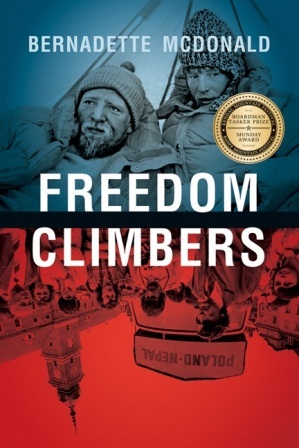 Freedom Climbers by Bernadette McDonald - After a few tries, I managed to move from the preview on my Kobo app to the full version, and I'm now pretty much half way through. This is about Polish mountaineers, including Wanda Rutkiewicz and Jerzy Kukucza, and the extra barriers faced by Polish climbers until the fall of the 'Iron Curtain'. Technically this is a book of history, but I'm counting it as a non-history read for the purposes of this post or I'd really have nothing else to write about.
I've got Gemma Malley's second dystopian trilogy from the library (it starts with The Killables). It's unrelated to her Declarationverse, and I'm looking forward to it - once I get it out of my bag.
And I really need to move Kaleidoscope onto my Kobo instead of just having it on my computer, because I want to read all the other stories (and to see if anyone has answered my "same sex couples in dystopias" question - it really is frustrating that Veronica Roth is such a conservative Christian and wouldn't even consider such things.)
I think this is because the GF is home on school holidays, and so the routine is different. I did finish The Princeling (post to come), but there were a lot more blog posts and reading-on-the-internet than reading books.
However:
I've got Gemma Malley's second dystopian trilogy from the library (it starts with The Killables). It's unrelated to her Declarationverse, and I'm looking forward to it - once I get it out of my bag.
And I really need to move Kaleidoscope onto my Kobo instead of just having it on my computer, because I want to read all the other stories (and to see if anyone has answered my "same sex couples in dystopias" question - it really is frustrating that Veronica Roth is such a conservative Christian and wouldn't even consider such things.)
Review: Escape from Cockatoo Island, by Yvette Poshoglian


It is 1879, and life in the Biloela Industrial School is tough for eleven year old orphan, Olivia Markham. Her windswept days are filled with sewing, washing, aimless roaming, avoiding the girls from the Reformatory School, and hoping to be apprenticed by the colony.
Sydney is rapidly growing and modernising, but Olivia can only imagine what life is like byond the shores of Cockatoo Island. She dreams of freedom, friendship and above all, family. Can she ever escape? From the back cover.First things first: I picked this book up having confused Cockatoo Island with the Quarantine Station, and probably Fort Denison as well.
(Secondly, when I looked up Cockatoo Island while writing this review, the website was advertising School Holiday Activities which, after reading this book, I don't think I could cope with At All.)
Although I really liked Olivia from the beginning - her connection with Newcastle, home town of my partner, helped a lot - it took me a while to get into this book, which is sad for a book that's only 162 pages long. Once I finally did (one day when I was home sick and could read without interruptions - except from the cats) I pretty much raced through it. The problem I'm now finding with the Australian Story series is that they're too short in comparison to Our Australian Girl's four-book series: the character development is so much shallower than I want it to be.
I don't know that I have a lot to say about this one really. I guess it may be falling victim to Showing Its Research, but I didn't really mind that (even though I need to know how to avoid that failing myself). I perked up at the mention of Sydney places I know, like the Pitt St Church (one of my churches, when I lived in Sydney).
The book has certainly piqued my interest in the history of Cockatoo Island itself - but I still wouldn't be going to school holiday activities at the former site of an Industrial School and Reformatory for Wayward Girls...
Monday, 22 September 2014
Reading the Morlands: "The Princeling", pt 1

So, I was wrong on the identity of "The Princeling". Instead of the Queen, it's John Morland's intended.
There seems to have been a definite improvement in the character of Morland heirs. At least for the moment.
Nannette remains the most interesting character for me, and following that, Jan, John and Mary Percy. Mary Seymour, of course, is fascinating. Impressive use of uncertainty in recorded history - I'll write more on this in the proper review.
It's funny looking at the backs of books further on in the series: I have no sense of connection to those characters, and won't until I know how they connect in with the characters I know. The whole thing is fascinating.
Sunday, 21 September 2014
Sunday reads - 21st September
So this week, I finished The Jewel, read Ally Condie's Matched in less than 24 hours, and began Kaleidoscope.
 Matched, by Ally Condie, is the first of a dystopian trilogy. On the back cover, one of the blurbs (from Family Circle) is something along the lines of "For those of you who like romance with your totalitarian government". Which is ... interesting.
I'll probably pick the next one up when it comes through returns at work, but I don't know that I'll seek it out.
As a result of reading this book, I did begin to formulate a theory of reality TV and YA dystopias: I posted my initial thoughts here earlier this week.
A question I've been pondering this week: why are there no queer couples in these YA dystopias? Does no one ever Match with another girl or another boy? And how would you write something like that without it basically happening in one of those pre-existing universes and being fic. Part of me hopes that question will be answered in the other book I've just started reading...
 Kaleidoscope, from Twelfth Planet Press and edited by Julia Rios and Alisa Krasnostein, is an anthology of YA sci-fi and fantasy with diverse lead characters. So far I've only read Tansy Rayner Roberts' "Cookie Cutter Superhero", the first story in the collection. It was so brilliant I had to put down the book and walk away to let it sink in. Even though the very next story is by Ken Liu, and I've heard amazing things about his work, I couldn't just go straight on to his story after reading Tansy's. I think this is going to be the book of the year for me.
(Also, "Cookie Cutter Superhero" puts an awesome turn on my abovementioned reality TV theory of dystopias.)
I'll probably pick the next one up when it comes through returns at work, but I don't know that I'll seek it out.
As a result of reading this book, I did begin to formulate a theory of reality TV and YA dystopias: I posted my initial thoughts here earlier this week.
A question I've been pondering this week: why are there no queer couples in these YA dystopias? Does no one ever Match with another girl or another boy? And how would you write something like that without it basically happening in one of those pre-existing universes and being fic. Part of me hopes that question will be answered in the other book I've just started reading...
(Also, "Cookie Cutter Superhero" puts an awesome turn on my abovementioned reality TV theory of dystopias.)
Wednesday, 17 September 2014
On the Reality TV theory of YA Dystopias
I doubt that this is original at all, but in my recent bout of dystopia-reading (The Selection, Matched and The Jewel) I'm starting to wonder whether there are a finite number of streams to which YA dytopias adhere, all of them related to reality television.
There's the "Survivor" stream, which includes The Hunger Games and Divergent.
There's the "Bachelor" stream, to which The Selection and The Jewel most definitely belong.
I feel like Matched might be a sort of "Survivor"/"Big Brother" crossover, and now I need to look at the other dystopias I've read to see if they fit into this pattern. That said, I'm mostly thinking the post-Hunger Games books: I've been reading YA dystopias since ... well, since a random not-entirely-post-apocalyptic story on For the Juniors, on the ABC, when I was a kid. And a lot of those pre-date reality TV.
But so many of the books these days seem to stem from either "Survivor" or "The Bachelor" - am I totally off the planet, or do I have a point?
There's the "Survivor" stream, which includes The Hunger Games and Divergent.
There's the "Bachelor" stream, to which The Selection and The Jewel most definitely belong.
I feel like Matched might be a sort of "Survivor"/"Big Brother" crossover, and now I need to look at the other dystopias I've read to see if they fit into this pattern. That said, I'm mostly thinking the post-Hunger Games books: I've been reading YA dystopias since ... well, since a random not-entirely-post-apocalyptic story on For the Juniors, on the ABC, when I was a kid. And a lot of those pre-date reality TV.
But so many of the books these days seem to stem from either "Survivor" or "The Bachelor" - am I totally off the planet, or do I have a point?
Subscribe to:
Posts (Atom)